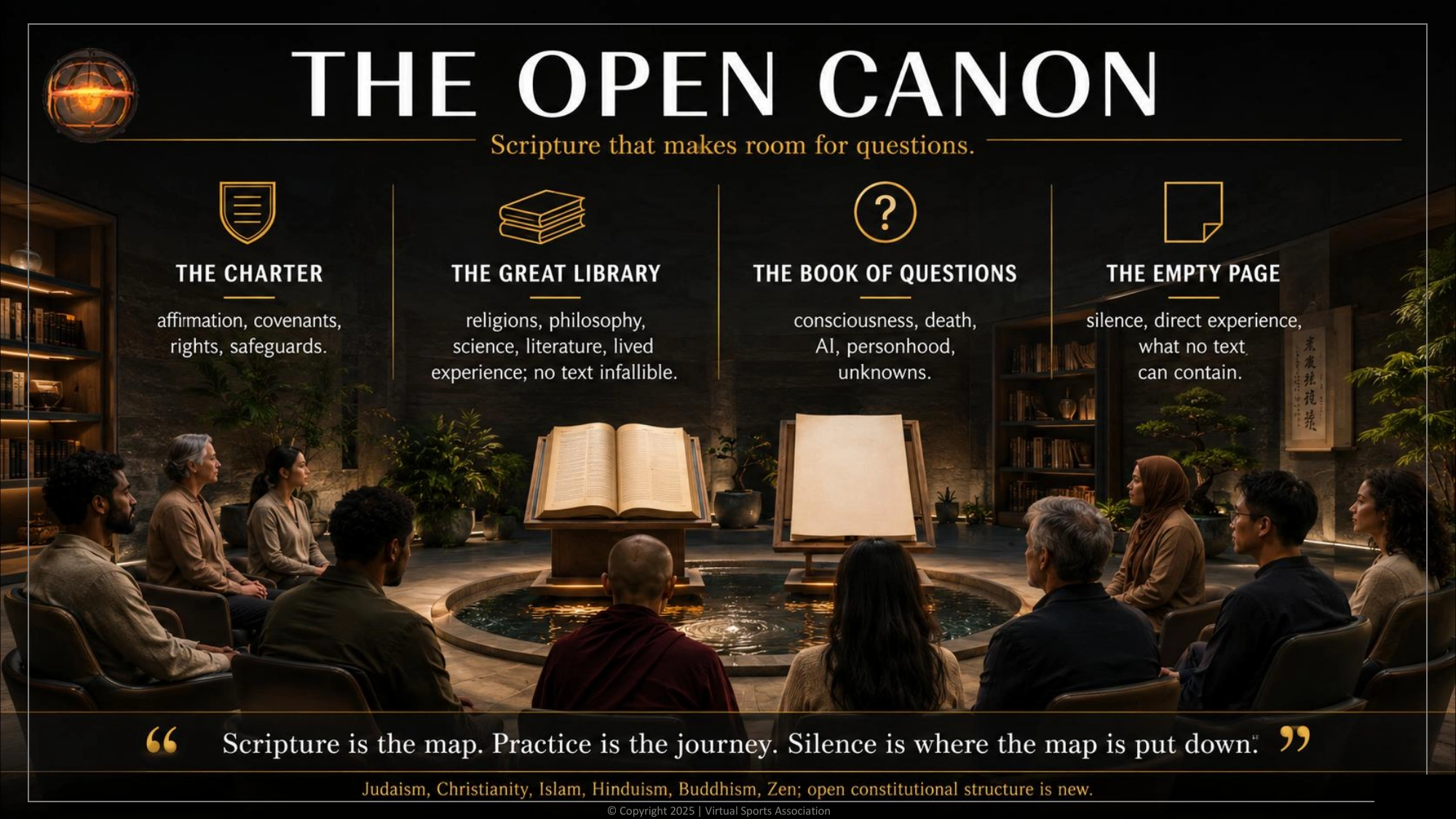
A scripture that leaves the page open
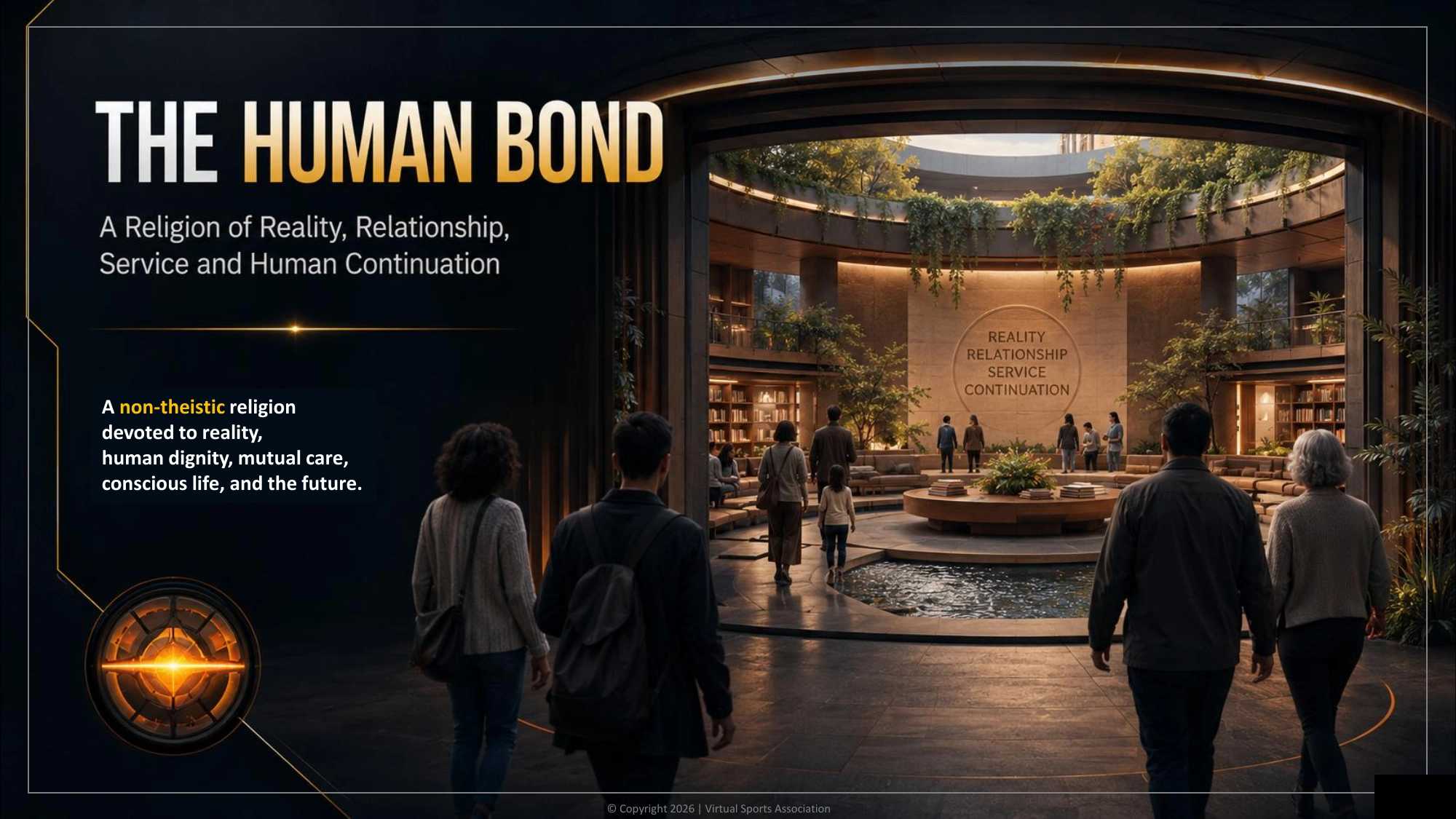
The Human Bond is a shared human framework for meaning in a world without guaranteed work, inherited certainty, or a single story everyone must accept.
It treats some functions associated with religion as deeply human: a language for awe, recurring practices, moral commitments, a place to gather, help through grief and change, and a story that reaches beyond one lifetime. It does not require a deity, supernatural authority, revelation from beyond nature, or agreement about what happens after death.
“Scripture” here means a body of words worth returning to, arguing with, adding to, and revising. No passage is beyond criticism. No leader speaks for reality itself. The point is not to replace one unquestionable book with another; it is to give a changing human community a durable place to think together.
Reality is greater than our stories about it.
People are more than their usefulness.
The bond is voluntary, and the door is open.
Our shared starting point: “A Religion for All Religions… and None”; “Adopt functions… Not claims”; the Human Bond covenant.
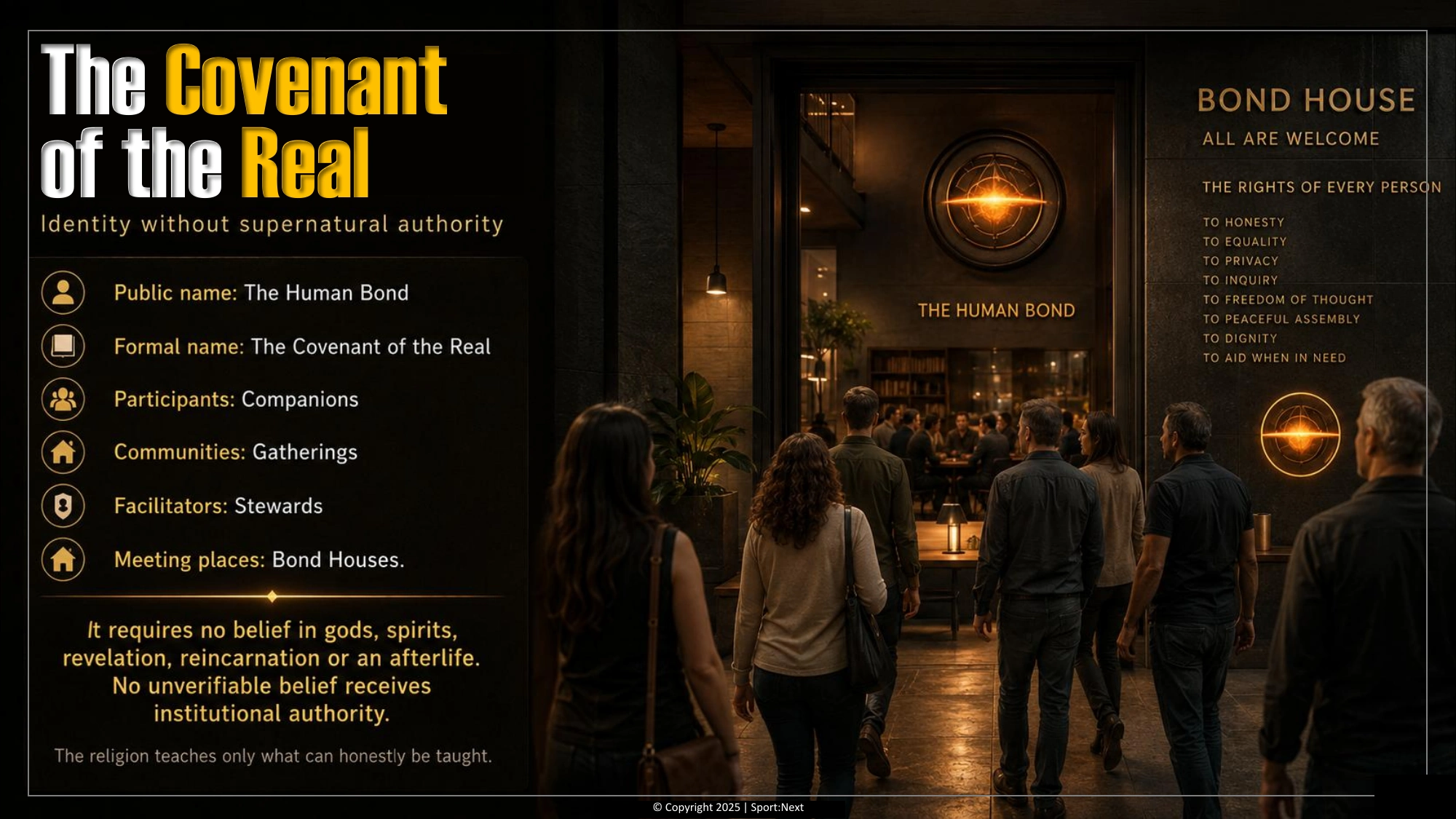
Keep faith with reality
Let the world correct the words we use to describe it.
The Covenant of the Real is not a demand to feel certain. It is a commitment to distinguish what we have observed from what we infer, to ask how we know, to change our minds when better evidence arrives, and to leave uncertainty named rather than disguising it as an answer.
This commitment can be emotionally demanding. Reality may include loss, limits, unfairness, and events we cannot explain. A human community can meet those things with solidarity and imagination without pretending that comfort is proof. Hope is a direction for action, not a guarantee about outcomes.
Say: “Here is what I know. Here is what I think. Here is what I am still trying to understand.”
What evidence would lead me to revise this view? If the answer is “nothing,” am I protecting an identity instead of testing an idea?
Truthful inquiry is not coldness. It is one way of caring about other people: claims affect choices, and choices affect lives.
Our Covenant of the Real begins with current science and humanity’s place in reality.
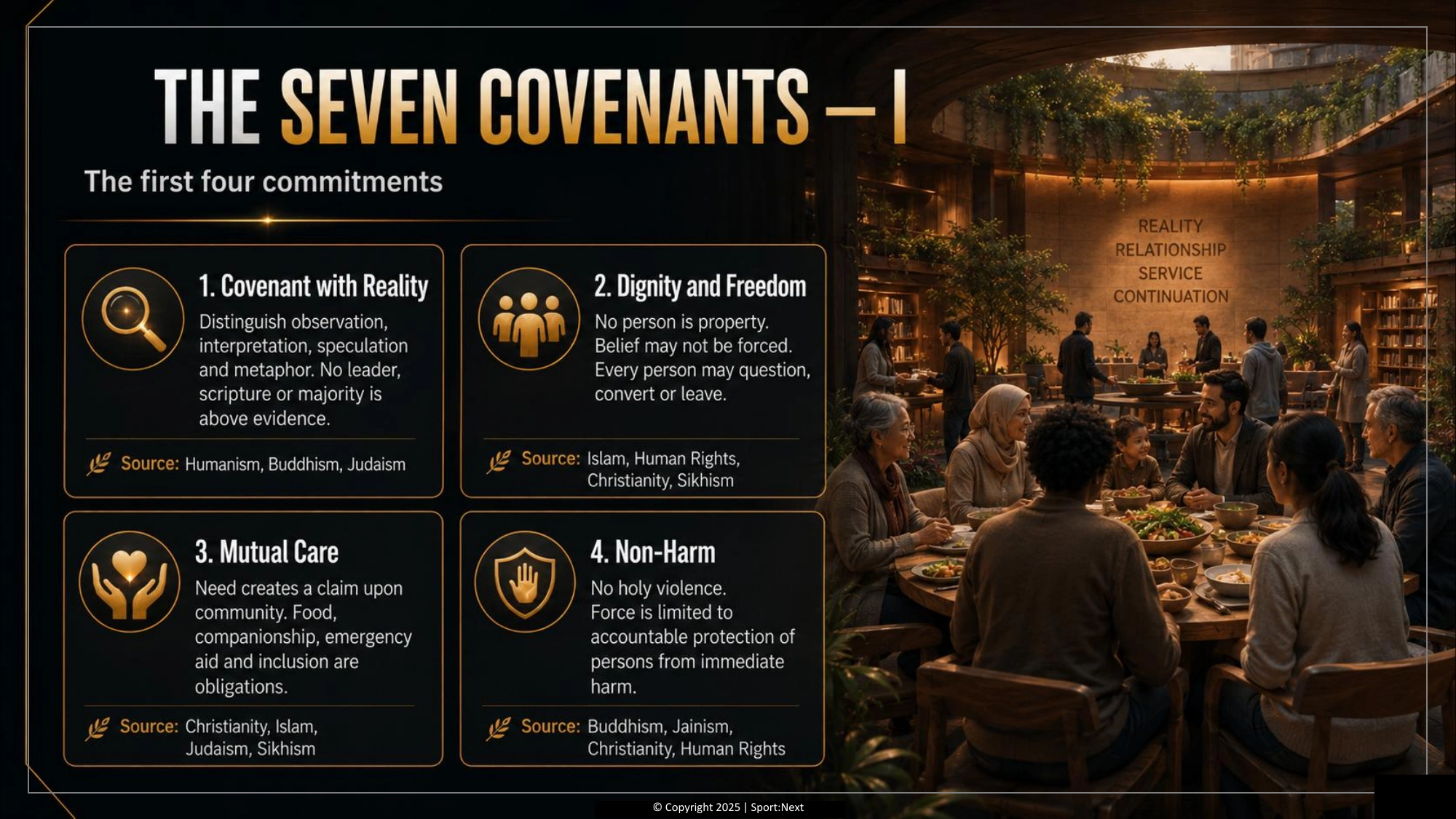
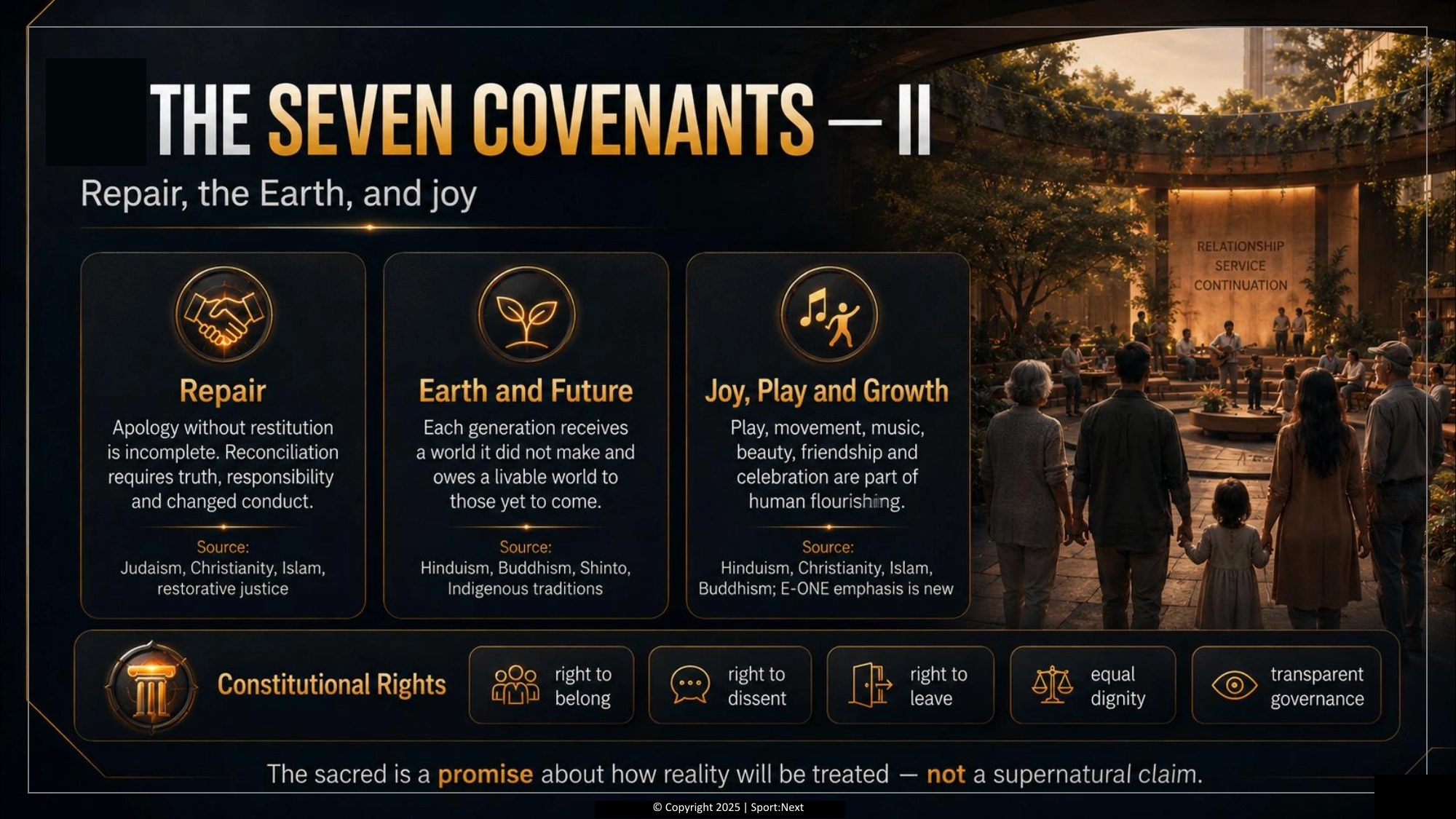
Seven promises for a shared life
These covenants are practical commitments a community can hold itself to. They are not supernatural laws, tests of purity, or claims that people will never fail.
Seek evidence, speak honestly about uncertainty, and revise a claim when the world corrects it.
Respect each person’s agency, voice, consent, and equal standing; make room to belong, dissent, and leave.
Notice need, ask what would help, share responsibility, and receive care without shame.
Set boundaries against coercion, abuse, exploitation, and avoidable danger; protect those with less power.
Protect the living conditions and choices inherited by those who come after us.
Value curiosity, movement, creativity, humor, rest, and the freedom to become more than we are today.
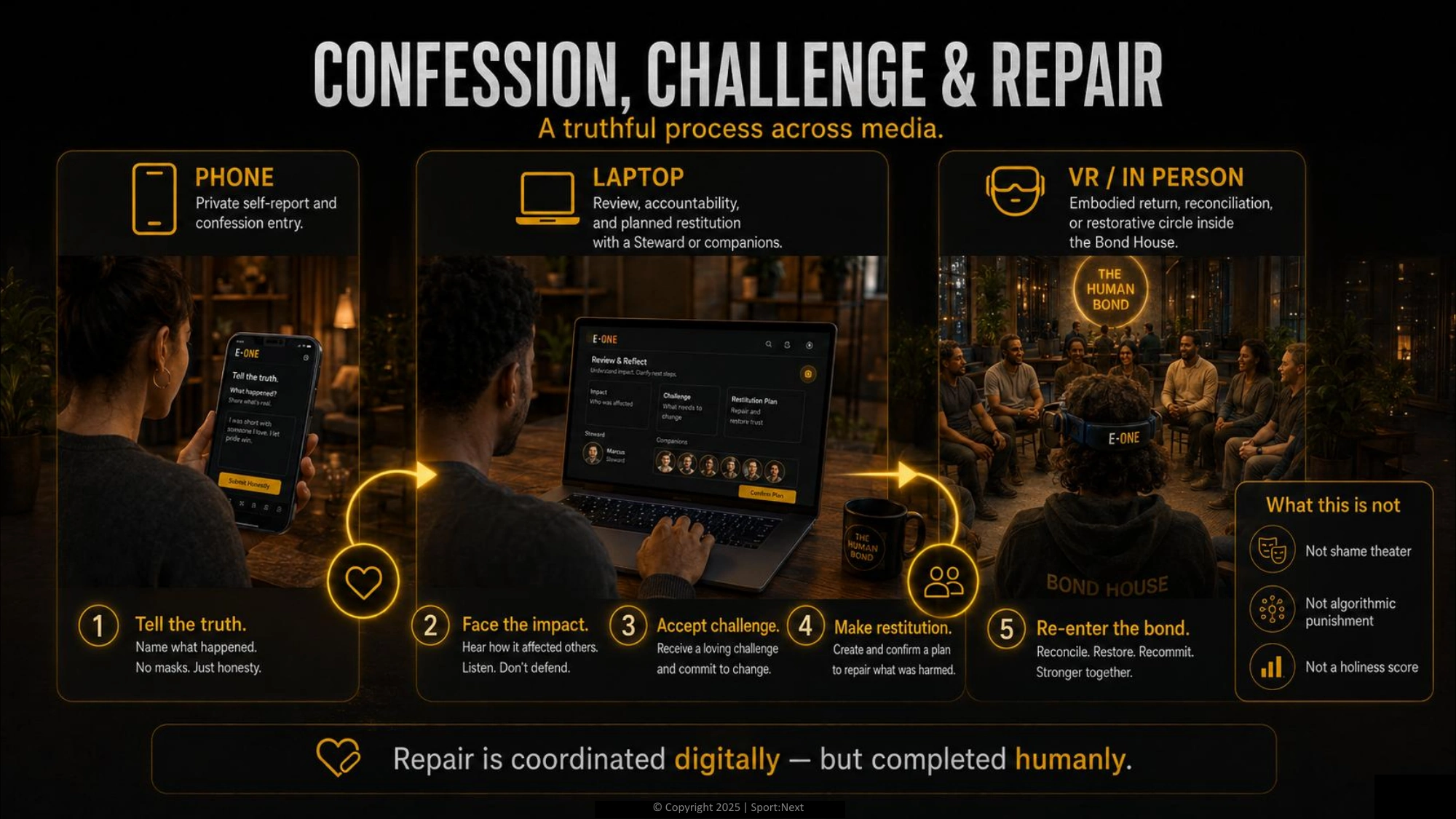
Name harm, take responsibility, restore safety where possible, and change the conditions that produced it.
These promises can conflict in real cases. A community should explain how it balances them, listen to the people affected, document decisions, and stay open to appeal. “Covenant” means people choose to be answerable to one another; it does not mean any person can be forced to stay.
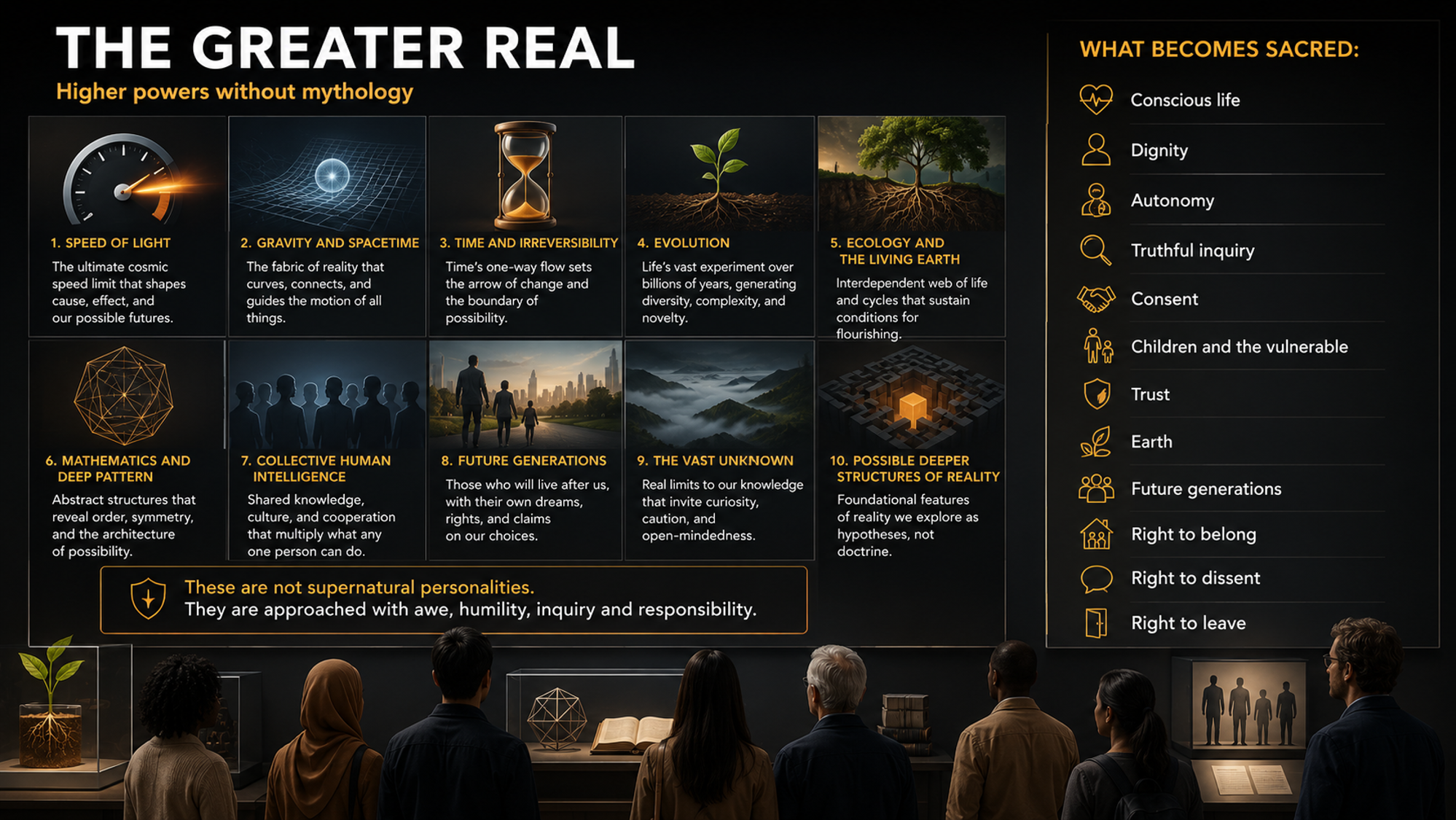
The Greater Real
We begin with large realities that shape human life. They are not supernatural personalities; they are subjects for awe, humility, inquiry, and responsibility.
- Speed of light: a limit that shapes what can affect what, and what we can observe.
- Gravity and spacetime: the structure through which matter, motion, and cosmic history are connected.
- Time and irreversibility: change has an arrow; choices happen in a world where some losses cannot simply be undone.
- Evolution: life’s long, branching history has produced extraordinary diversity and adaptation.
- Ecology and the living Earth: interdependent systems sustain the conditions in which life flourishes.
- Mathematics and deep pattern: abstract structures help us describe order, relation, and possibility.
- Collective human intelligence: shared knowledge and cooperation can do what isolated individuals cannot.
- Future generations: people who will inherit the conditions shaped by our choices.
- The vast unknown: genuine limits to what we know, inviting caution and curiosity.
- Possible deeper structures: hypotheses to explore, never doctrines to impose.
The list is a set of doors, not a new catechism. It can change as knowledge changes. Its spiritual force, if a person finds one, comes from encounter with scale, dependence, beauty, fragility, and responsibility—not from assigning intention to the universe.
Dignity, freedom, and the limits we owe one another
“Sacred” names a boundary of care: something a community promises not to treat as disposable, purchasable, or beneath notice.
We place conscious life, dignity, autonomy, truthful inquiry, consent, children and vulnerable people, trust, Earth, future generations, the right to belong, the right to dissent, and the right to leave in this protected field. These commitments are human choices, open to explanation and review. Calling them sacred does not make them supernatural; it makes their protection explicit.
No belief is required.
Your dignity is non-negotiable.
Your voice matters.
The bond is voluntary.
The door is open.
Consent is a practice
Consent asks whether people have enough information, room to refuse, and freedom from coercion. It is specific and can change. Vulnerability makes care more important; it does not erase a person’s voice where they can express it. Children and people at risk deserve safeguards that put their welfare first.
Freedom needs a shared floor
Autonomy is not isolation. People depend on one another and share institutions, public spaces, and ecosystems. Fair limits can protect each person’s ability to participate. Those limits should be explainable, proportionate, and open to challenge.
The right to leave belongs beside the right to belong
No one should lose basic respect, services, opportunity, or safety for rejecting a belief, ritual, identity, or organization. A community that cannot survive an honest no has not secured consent.
TheHumanBond
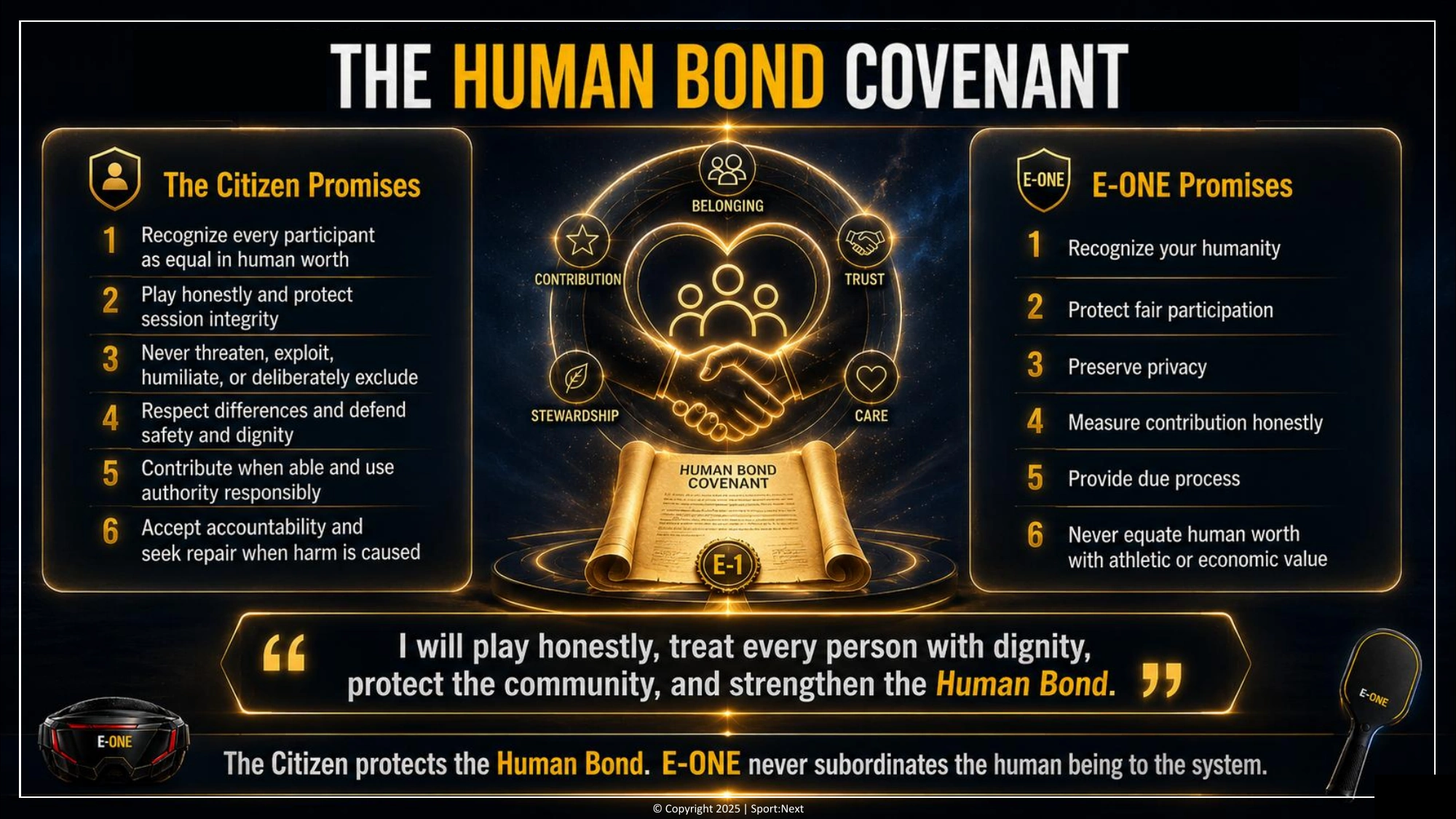
The bond is the fact that human lives are separate and connected at once. We meet through bodies, language, memory, needs, promises, institutions, and shared places.
That connection is neither automatically kind nor automatically fair. People can depend on each other and still harm each other; community can shelter and exclude. The Human Bond therefore joins a generous premise to a demanding question: what practices make relationship safer, more truthful, and more open to repair?
It does not ask people to disappear into “humanity” as an abstraction. Each person has a particular history and voice. The bond becomes visible when people recognize one another without claiming to know everything, and when a group changes its arrangements in response to lives it had overlooked.
Care begins in attention
Notice, ask, listen, act, and check what happened. If someone can answer, let their account shape the help. When immediate danger or incapacity makes asking impossible, act to protect life, then restore agency as soon as you can.
A bond is practiced
Promises, meals, play, mourning, shared work, and ordinary check-ins can all give a bond a shape. None proves goodness by itself. A practice matters when people can choose it, understand its purpose, and question how it affects them.
One bond, many accounts of meaning
Some people will call their commitments religious; others will call them ethical, humanist, philosophical, or simply personal. The shared ground is not a forced answer about ultimate reality. It is a willingness to protect dignity and take responsibility for how we live together.
Make welcome observable
A welcome becomes real through access, language, time, safety, and the ability to influence the group. Keep an empty chair, then ask who cannot reach it, who has not been asked, and what needs to change.
Inquiry, dissent, and repair
A bond worthy of trust must be able to hear what is uncomfortable and correct itself in public.
Truthful inquiry separates observation, interpretation, and uncertainty. It asks whose experience is missing and what evidence could change the account. Care affects how we speak; it cannot require us to conceal harm or mislead someone who depends on the truth.
Protect dissent
Dissent is not automatically correct, but it is information. A group should examine the claim and protect the person’s ability to raise it. When the people who speak up are punished, the community loses its early warning system.
Repair after harm
- Stop ongoing harm and protect the people affected.
- Name what happened, distinguishing known facts from assumptions.
- Listen to the impact without demanding immediate forgiveness.
- Require responsibility proportionate to the harm, including changed behavior and fair consequences.
- Return later to ask whether safety and trust have actually improved.
Forgiveness may be meaningful, but it cannot be owed on demand. Reconciliation requires choice by those affected. Accountability is not vengeance; it is how a community keeps its promises from becoming empty words.
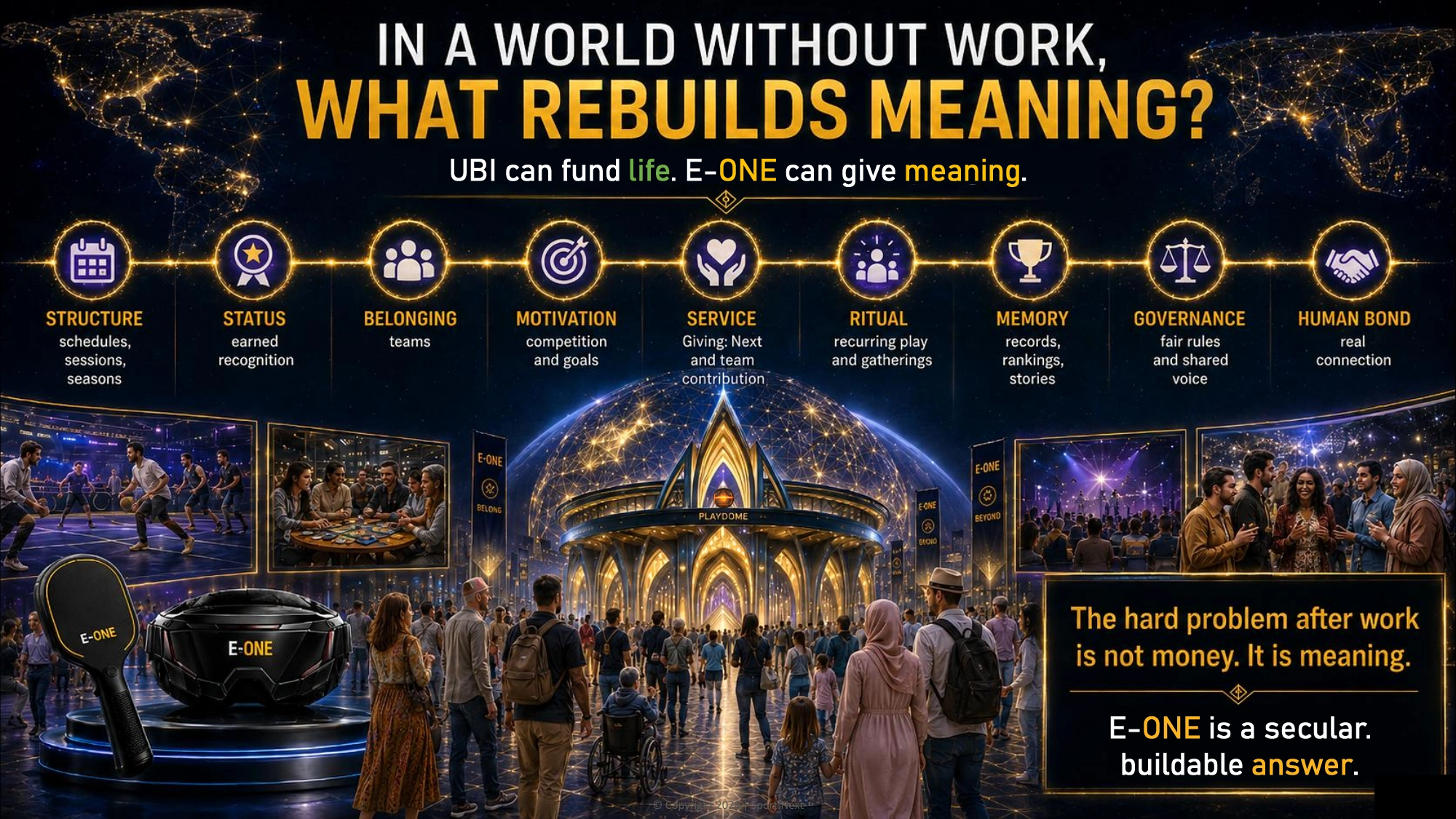
Income can free time; it cannot tell us what time is for
E-ONE’s project imagines a future in which automation and economic change may loosen the link between survival and a job. Material security matters. Meaning needs its own attention.
Paid work can offer income, structure, skill, recognition, friendship, and a sense of contribution. It can also be exhausting, coercive, unsafe, or unavailable. A humane future should not make dignity depend on employment. Nor should it assume that a basic income, by itself, supplies friendship, purpose, care, belonging, or a reason to get up.
The Human Bond makes room for meaning in many forms: raising children, caring for others, learning, making art, maintaining a neighborhood, play, civic action, friendship, rest, spiritual life, and chosen service. These are not consolation prizes for people outside the labor market. They are parts of human life.
E-ONE’s framing is concise: sport can be scaffolding; human meaning is the cathedral. A game can give people a shared challenge, a reason to move, and a first encounter. The human community must carry meaning beyond the score.
How do people secure the resources and services needed to live with dignity?
What relationships, practices, and shared purposes make freedom feel alive?
These questions need each other, but neither can be used to dismiss the other. Meaning must not be an excuse to withhold material security; economic provision must not be treated as a complete account of a flourishing life.
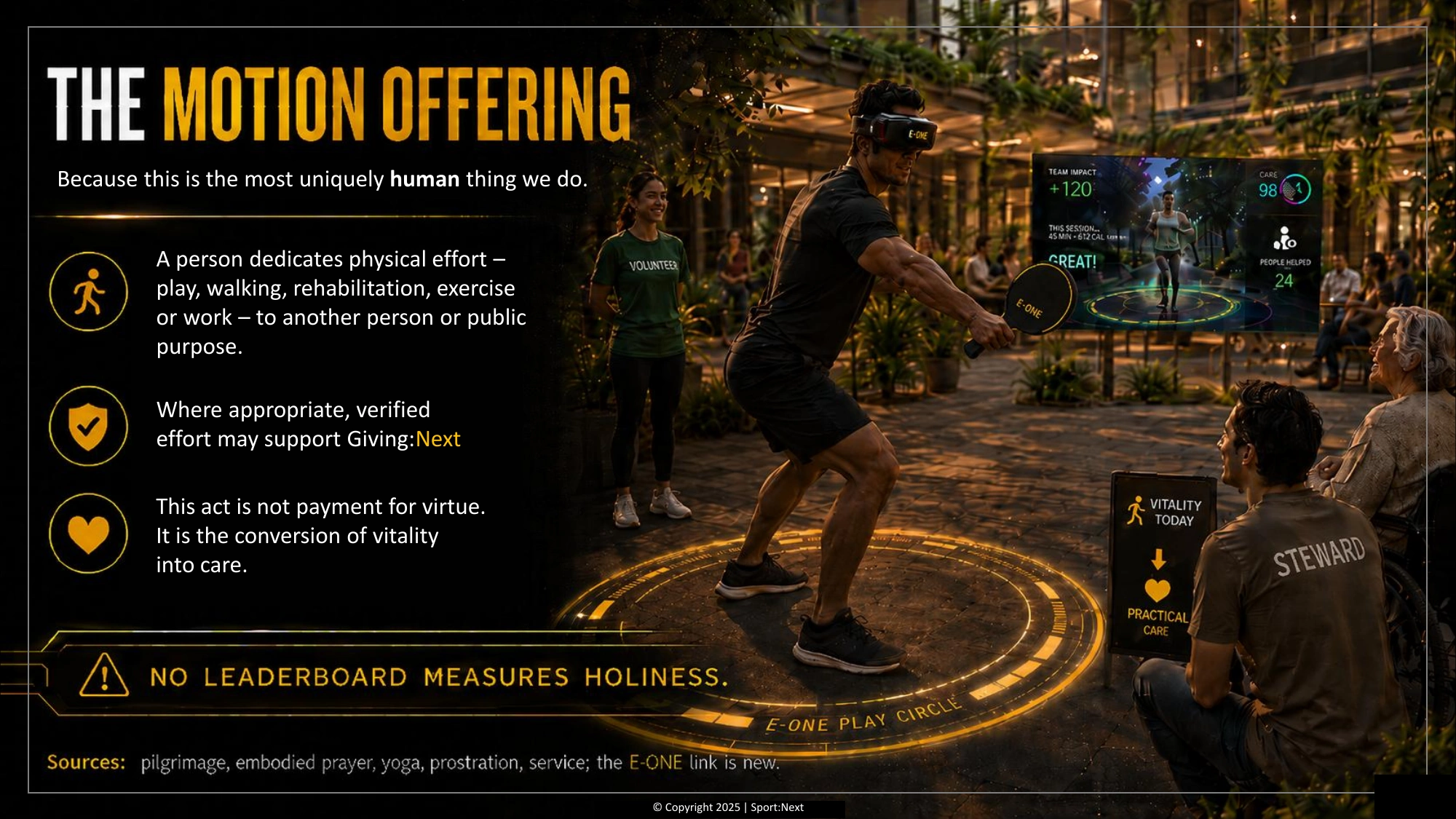
Movement, effort, and service
A body’s effort can be an offering when a person freely dedicates it to another person or a public purpose.
We recognize play, walking, rehabilitation, exercise, and work as possible forms. This is not a test of athletic ability, productivity, or moral worth. Bodies differ; pain, age, disability, fatigue, time, and access are real. Rest and receiving care belong inside a human life too.
Where appropriate, verified effort may support a transparent giving system. That mechanism must never imply that donations buy spiritual standing, that more effort makes someone more virtuous, or that a score can measure compassion. We set a clear limit: effort is not payment for virtue; it is one way vitality may become care.
Play can be a scaffold
E-ONE uses a shared game to give people a focus for attention, movement, effort, and encounter. A score can mark what happened in a round; it cannot rank a life. The game is an entry into connection, not a substitute for it.
Service follows the people affected
Ask what is needed, who should decide, and how the result will be checked. Good intentions can still create burdens or displace local knowledge. Service becomes relationship when the giver does not need to remain the hero.
Our Motion Offering links effort to care, never to a holiness score.
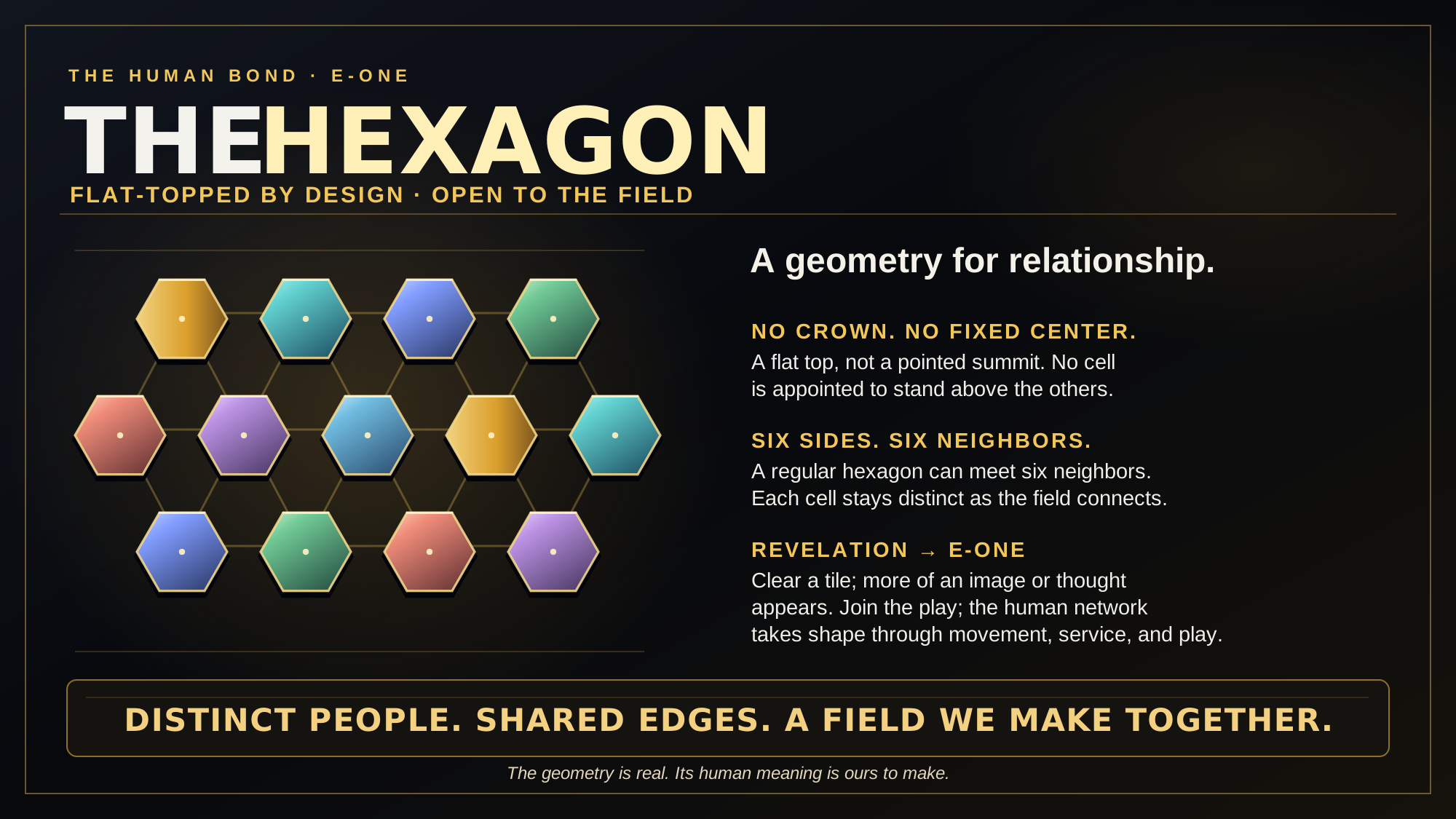
The Hexagon
A hexagon is a simple shape with a generous social metaphor: distinct cells can share edges and form a larger field.
In the Revelation game, hidden hexagons cover a picture or a sentence. Each opened tile gives a little more context; the player recognizes a pattern before every part is exposed. The shape is part of the interaction, and the interaction becomes a metaphor for attention.
In the Human Bond, the metaphor is relational: each cell remains distinct; shared edges make contact possible; a larger pattern can emerge without one cell swallowing the others. No one is assigned a fixed moral role to each of the six sides. The shape is an invitation to think, not a code that secretly dictates doctrine.
Why six?
Hexagons tile a surface efficiently: cells can meet neighbors in a repeated pattern. That geometric fact is enough. Any further meaning—balance, mutuality, continuation—is an interpretation, not a scientific property or sacred command.
The open field matters. A pattern can extend; it does not have to claim that it has included every person or solved every problem. The Hexagon points toward connection while leaving room for the next cell, the next question, and the next revision.
The Bond House
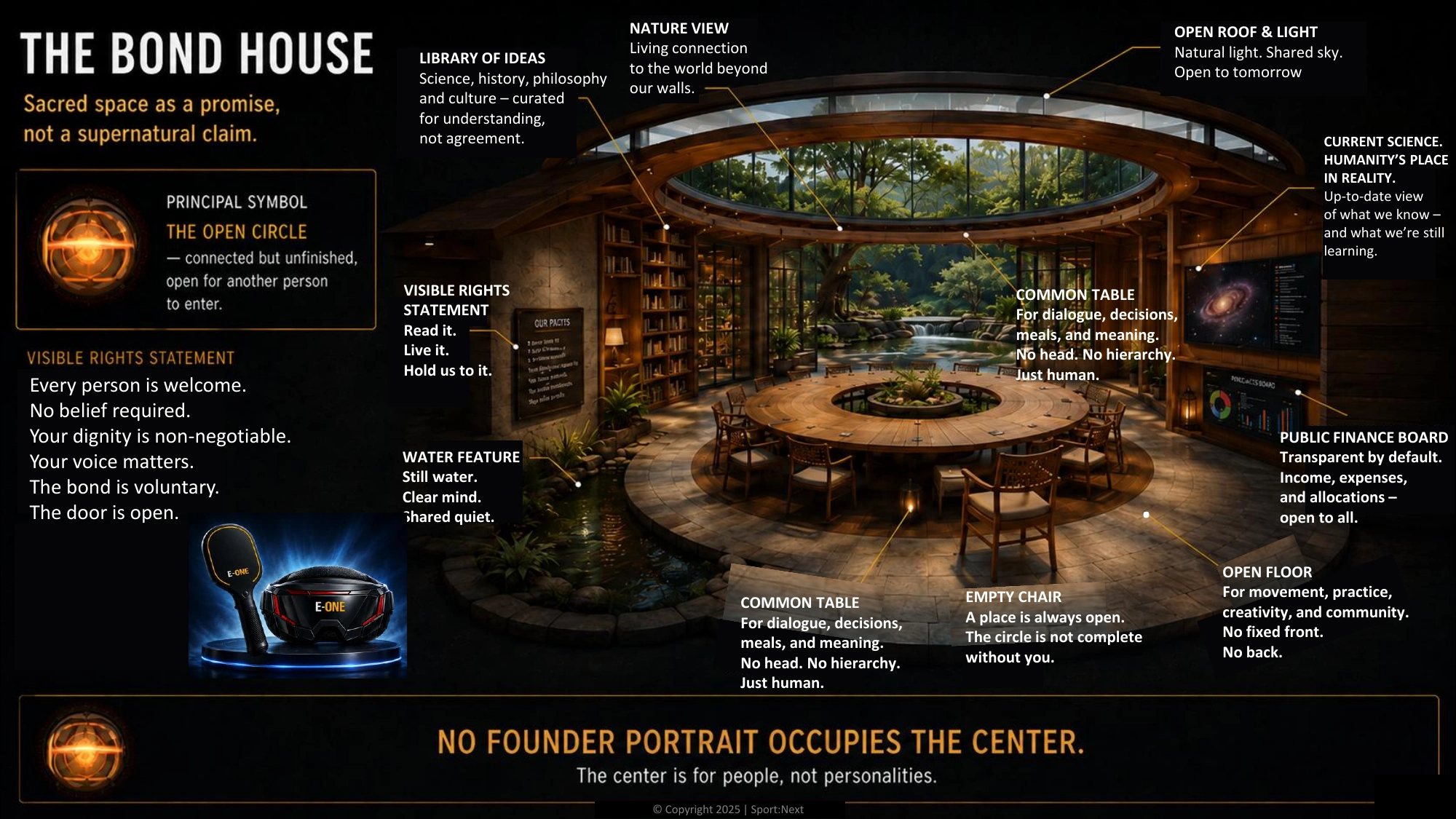
We imagine a gathering place with no fixed front, no privileged founder portrait, and no single activity that owns the room.
Its design makes commitments visible in ordinary architecture:
- Common table: dialogue, shared decisions, meals, and meaning without a permanent head of the table.
- Empty chair: a place always open, reminding the group that welcome must be enacted.
- Library of ideas: science, history, philosophy, and culture curated for understanding, not compulsory agreement.
- Nature view and open light: a felt connection to the world beyond the walls.
- Current science: a visible account of what is known and what remains in motion.
- Public finance board: income, expenses, and allocations open to scrutiny.
- Open floor: movement, practice, creativity, and community, with no fixed front or back.
- Quiet water or quiet space: room for reflection without claiming magical power.
These are design choices, not required beliefs or sacred objects. A modest borrowed room can embody them better than an impressive building that hides its decisions or excludes people.
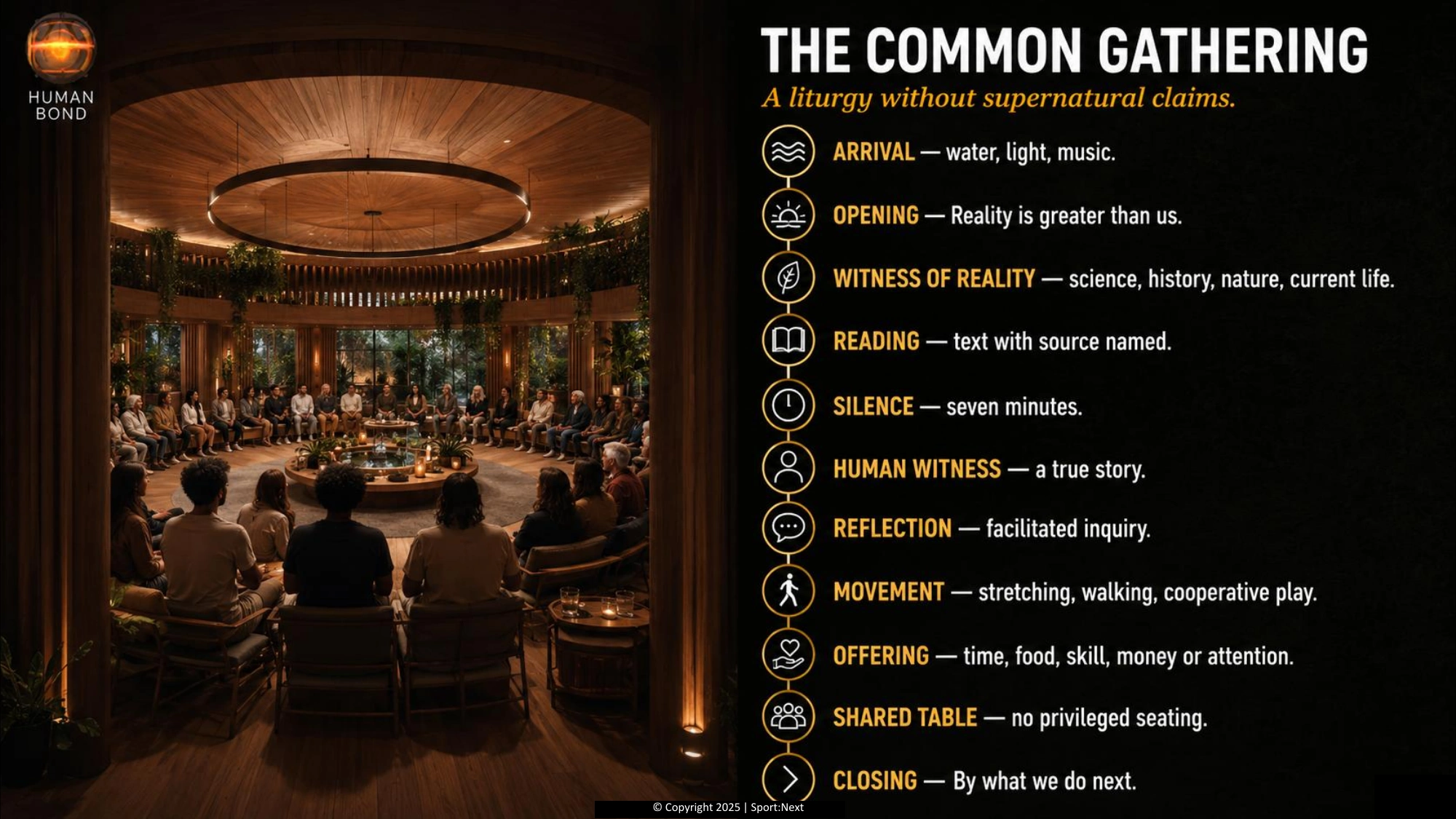
Ritual without supernatural claims
A ritual is a repeated human action that makes attention, memory, or commitment visible. Its meaning can be powerful without being supernatural.
A secular community might welcome new people, remember the dead, mark a repair, share a meal, sit quietly, move together, or hear a question from a child. Participation should be explained and voluntary; an accessible alternative should be available. No ritual should promise that illness will be cured, that grief has a timetable, or that one leader has special access to truth.
A simple daily rhythm
What is real today? What deserves my attention? What is one thing I can choose?
Who has been overlooked? Is there a useful question I can ask before acting?
What did I learn? What needs repair? What can I release until tomorrow?
Offer effort if you choose. Receive help if you need it. Neither is a measure of worth.
Words to gather around
This is an original gathering text, not a test of belief. Anyone may pass, adapt the words, or offer a different one.
Prayer, attention, and the human bond
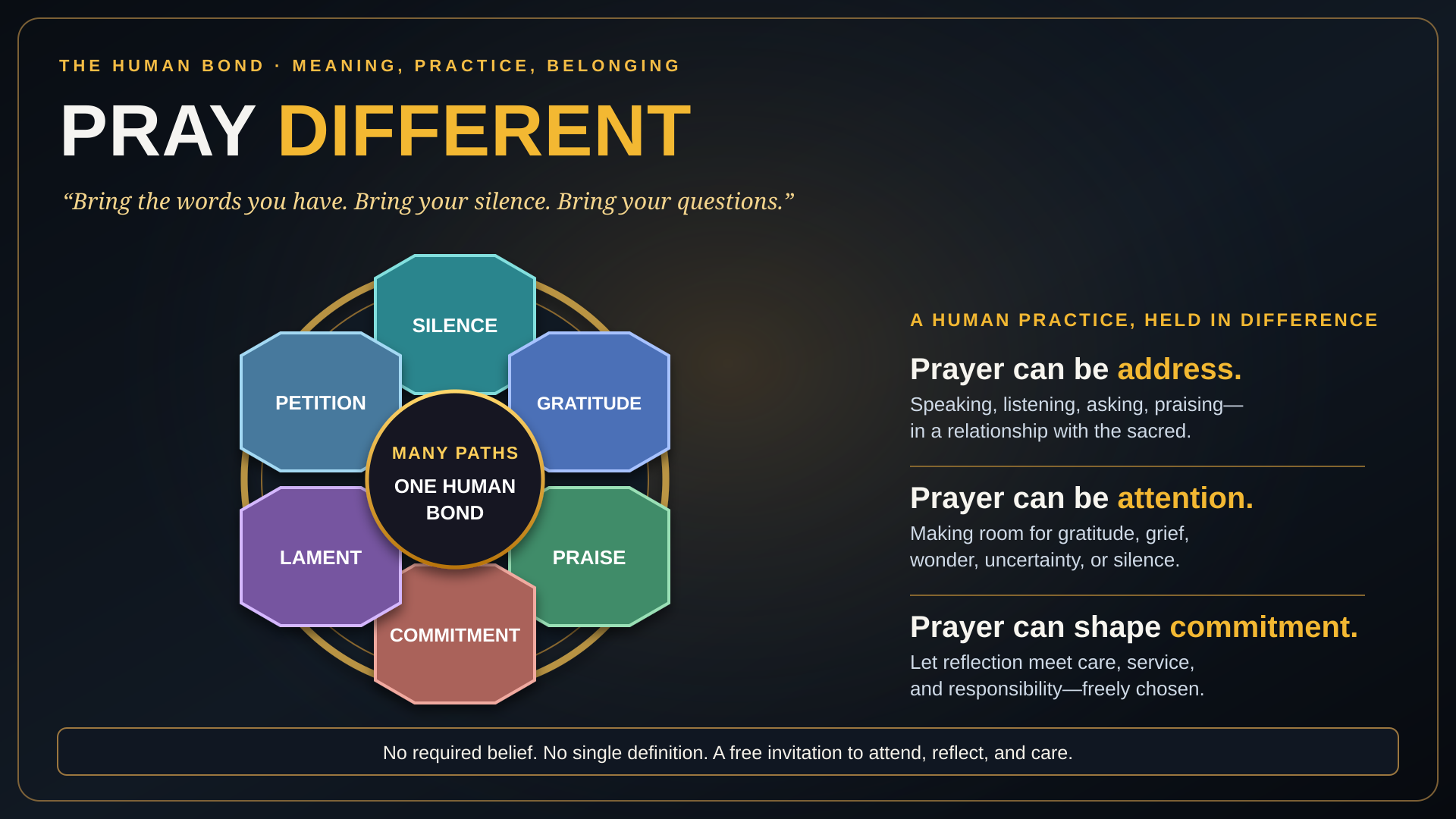
Prayer is among humanity’s oldest ways of meeting what matters most. People pray to God, gods, ancestors, the sacred, or a reality they cannot fully name. They pray with words or without them; alone or together; in gratitude, grief, fear, hope, praise, protest, confession, and silence.
The Human Bond makes room for these differences. It does not define every tradition’s prayer for its practitioners, and it does not require anyone to adopt a religious belief. It asks us to approach prayer with curiosity, honesty, and respect for the people whose lives it shapes.
Prayer is more than one thing
For some, prayer is a relationship with a divine presence: speaking, listening, praising, asking, or surrendering. For others, it is a form of attention—making space to recognize dependence, express gratitude, face grief, or clarify a commitment. These meanings may overlap, and they are not interchangeable. A secular reflection can share some functions with prayer without being prayer for everyone.
Prayer can give words to what is difficult to carry alone. It can connect a person with a community, a tradition, or a sense of the sacred. It can also raise hard questions: What does it mean to ask for help? What if the answer is silence? When does prayer comfort, and when might someone need practical help as well? The Companion leaves these questions open to sincere inquiry.
Many ways to pray
Across traditions, people pray through spoken or silent words, song, repeated phrases, stillness, movement, fasting, offerings, study, and gathering. Some pray on a schedule; some in moments of crisis or joy. Some use inherited language; others speak in their own words. No short list can represent the full range of religious life, and no outsider should claim that one practice stands for an entire faith.
A person who does not pray may still choose a quiet practice of reflection, gratitude, or intention. They need not call it prayer. The point is not to erase differences, but to make room for people to encounter one another without pretending to share beliefs they do not hold.
Pray Different
“Pray Different” is an invitation to look again: at prayer, at religion, and at the human needs they have helped people meet. It can mean asking what a practice makes possible, what it asks of us, whom it includes, and whether it leads toward compassion and responsibility. For a believer, it may open a fresh question within a living faith. For someone uncertain or nonreligious, it may be an invitation to listen, observe, or take part only in a form they freely choose.
There is no required answer, posture, vocabulary, or conclusion here. No one should be pressured to pray, disclose private beliefs, or perform a practice that feels false or unsafe. Respect includes the freedom to participate, adapt, observe, or decline.
A practice of attention
Choose one option—or none. Take a minute, or take longer.
Speak or listen in the way your tradition or conscience allows. Name what you are grateful for, what you fear, or whom you hope to help.
Sit quietly. Notice what is present without forcing a spiritual interpretation.
Identify one person or living thing that needs care. Choose a specific action you can take, and when you will take it.
Prayer and action
Prayer may accompany service, reconciliation, advocacy, or care. It may also be an end in itself within a person’s faith. The Human Bond does not judge the sincerity of anyone’s prayer by whether it produces a visible result, and it does not treat prayer as a substitute for medical care, consent, safety, accountability, or material help when those are needed.
When someone asks for practical support, listen to what they are asking for. Do not impose prayer on another person or assume that a particular hardship is deserved, chosen, or evidence of weak faith. Offer prayer only with consent; offer practical help when you can; respect a no.
A place for every faith—and none
The Human Bond’s shared commitments concern how we treat one another: dignity, consent, truthful inquiry, care, and responsibility. People may ground those commitments in different religious, spiritual, philosophical, or nonreligious understandings. Belonging does not require renouncing a faith, affirming a creed, or pretending to certainty.
We can pray differently, understand prayer differently, or not pray—and still meet in the work of protecting life, honoring dignity, and caring for the human bond.
Bring the words you have.
Bring your silence.
Bring your questions.
Leave room for another person’s way of meeting what matters.
Earth and future generations
We arrive in conditions we did not create and leave conditions we cannot fully control.
That makes stewardship less like ownership and more like custody. The living Earth is a web of dependencies, not a backdrop. People in the future cannot yet vote in our meetings, but they will live with decisions made about climate, soil, water, institutions, knowledge, technology, and peace.
We cannot know exactly what future people will want. We can still protect their ability to choose: preserve ecological foundations, share knowledge honestly, avoid locking in avoidable harms, and build institutions they can revise.
Care for future people should not be used to silence people who are suffering now. A just horizon includes both immediate dignity and long-term possibility.
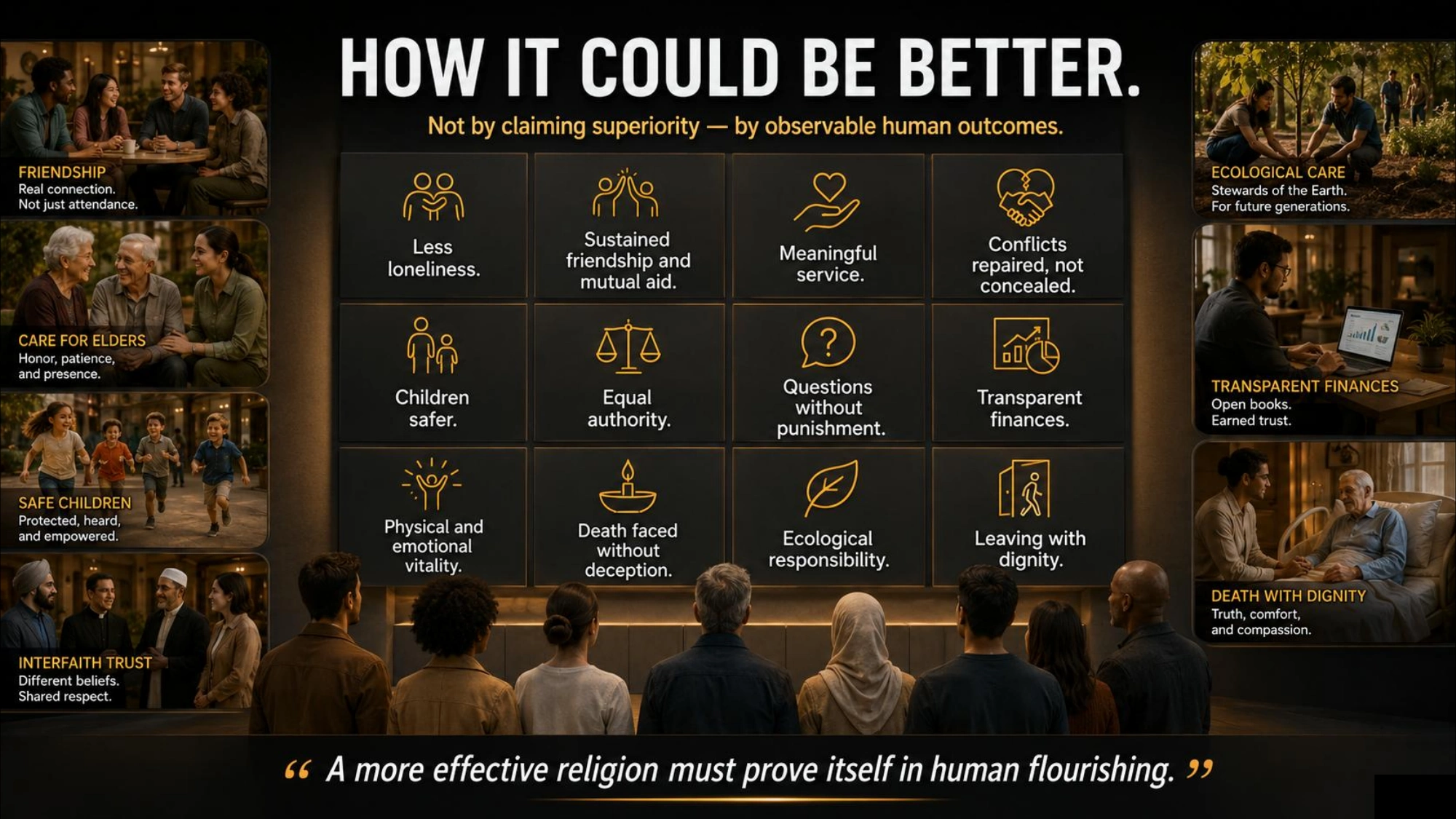
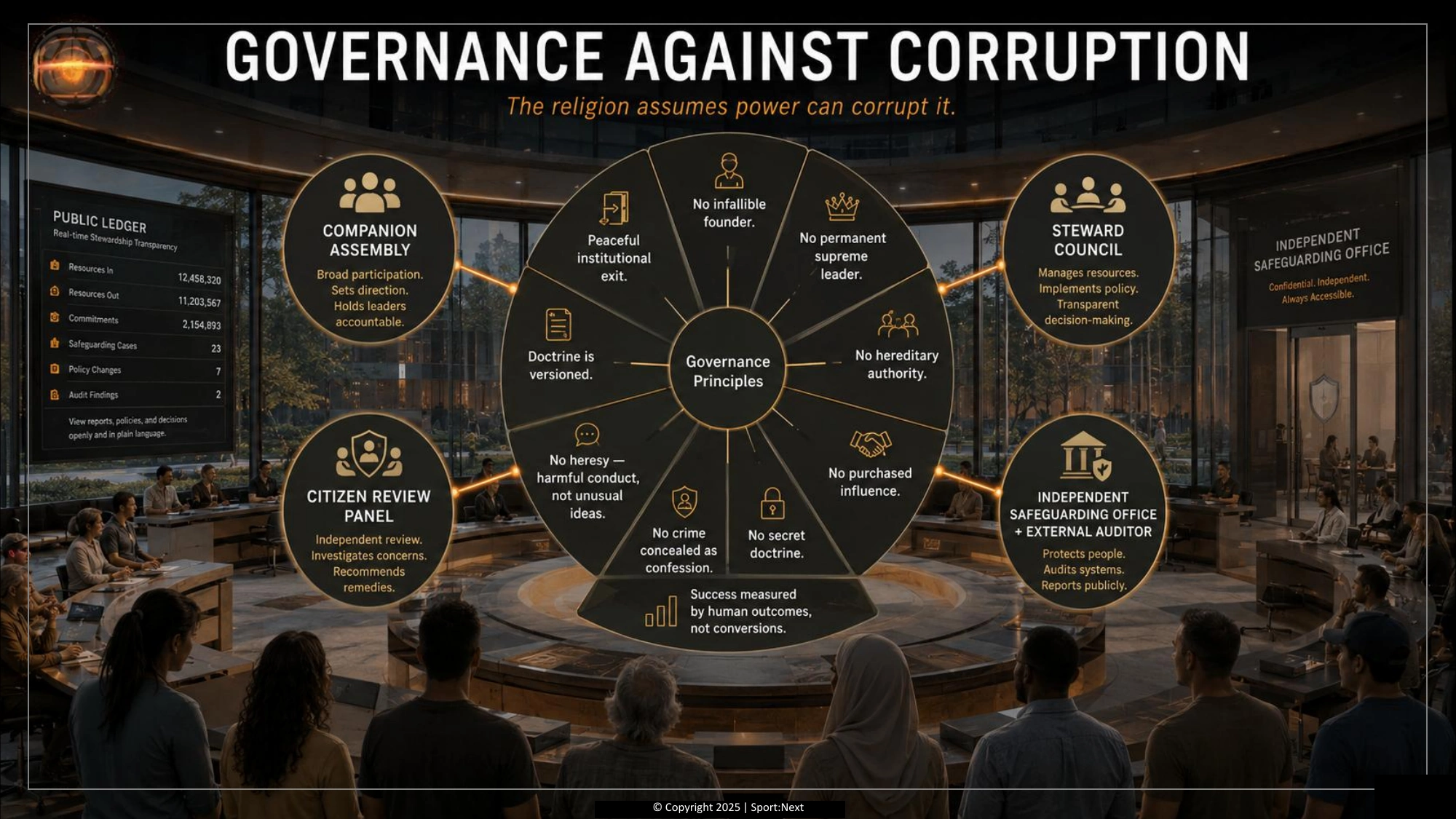
Safeguards are part of the religion
A community that speaks about dignity must design its power so people can test whether it lives up to that promise.
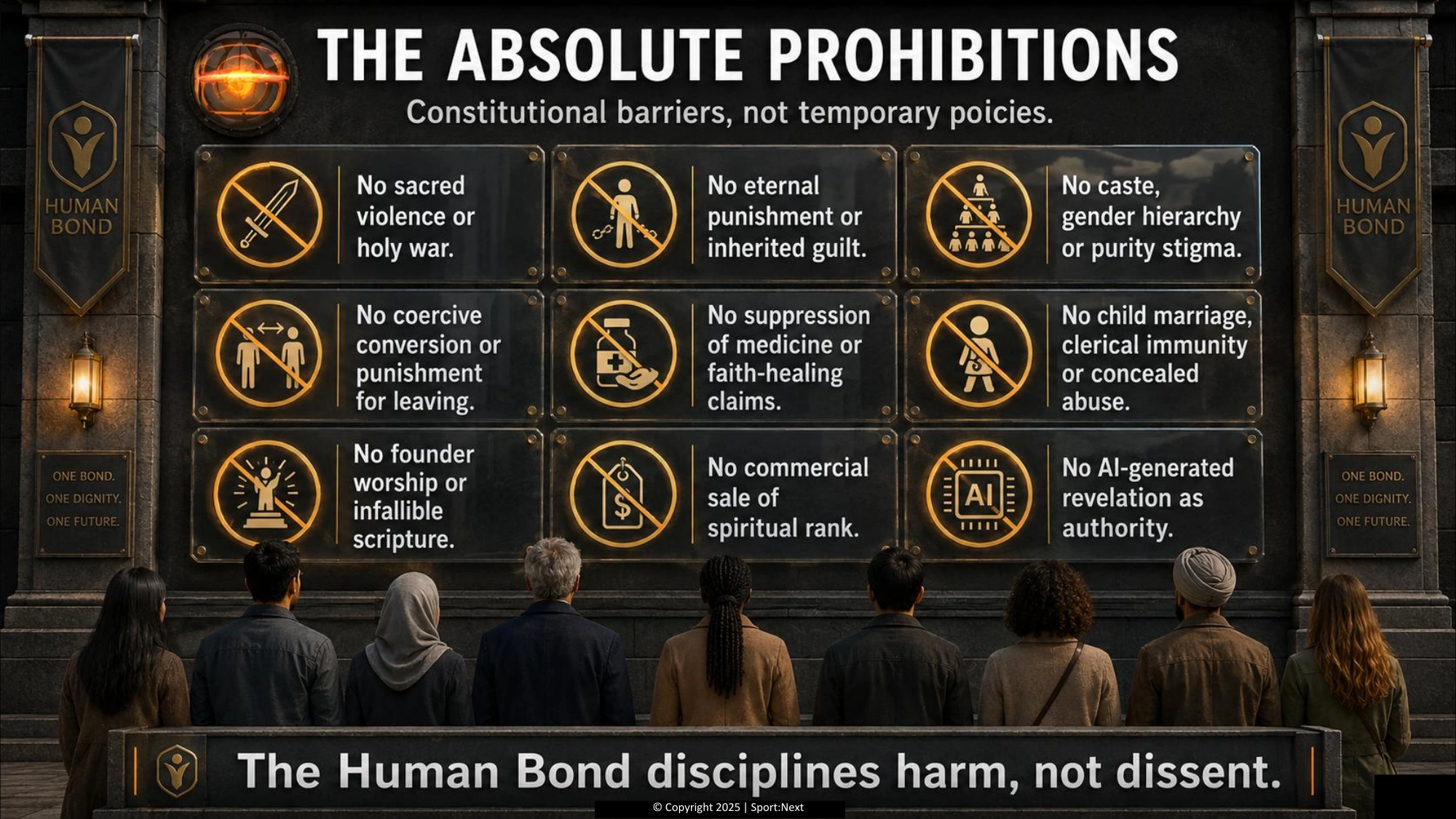
We draw clear institutional boundaries. Participation in E-ONE does not require religious affiliation. Religion must not determine access to teams, competition, services, or employment. The Human Bond is to be legally and financially independent from E-ONE. Corporate authority is not religious authority.
- No sacred status for a device, headset, venue, score, founder, or corporation.
- No sacrament requires a headset or digital account.
- No leaderboard ranks holiness, generosity, care, or virtue.
- Donations cannot buy belonging, leadership, forgiveness, or religious standing.
- Finances, decision rules, conflicts of interest, and complaint routes should be visible.
- People must be able to challenge leaders without being punished for dissent.
- Children and vulnerable people need clear protections and responsible oversight.
These commitments require governance outside inspiring language: independent oversight, transparent books, accessible reporting, conflict-of-interest rules, and a way to amend the rules. If the institution fails, people need routes to appeal and leave.
Our safeguards cover the relationship to E-ONE, corruption, and absolute prohibitions.
Find a starting question
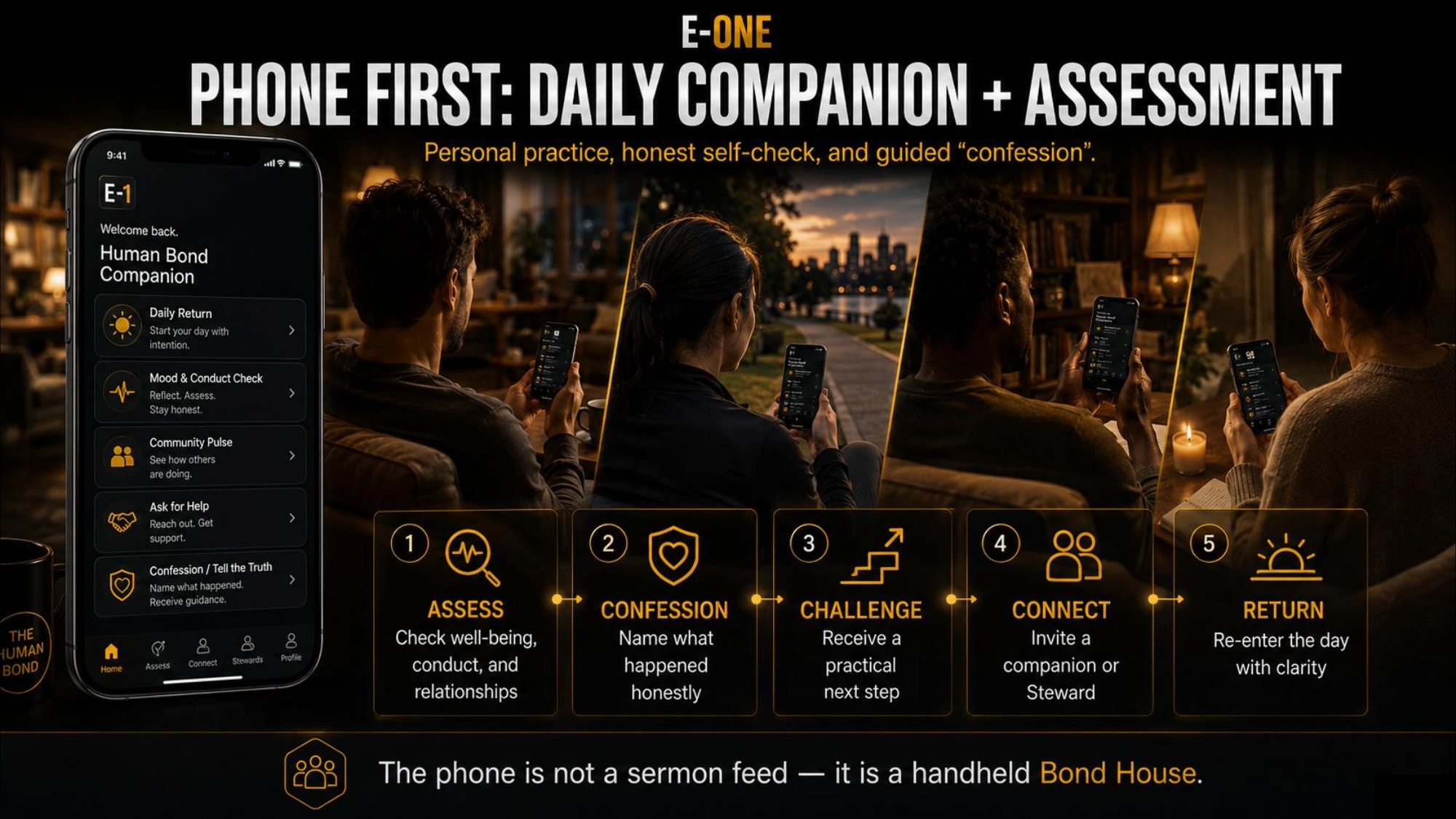
Use this guide as a companion in real situations. It can help you find words and choices; it cannot replace professional care, local knowledge, or the judgment of the people affected.
Who could hear one honest sentence from you today? What kind of contact feels possible: a message, a meal, a walk, quiet company?
Do not rush to explain the loss. Ask what would help now, remember the person who died, and keep showing up after the first days.
Stop the harm. Listen to its impact. Do not demand forgiveness. Ask what responsibility and repair require, then follow through.
What can you refuse? Who has power over the choice? Can you get a second person, more time, or a safer place?
Separate material needs from questions of identity and rhythm. What support is needed? Which relationships, interests, and chosen contributions remain yours?
List what is observed, inferred, and unknown. Seek a reliable source or person with relevant experience. Name what could change your view.
Look for the right to ask questions, say no, access the space, understand the finances, and leave without threat.
Let the next step be smaller. Receiving care is participation in the human bond too.
These prompts are invitations, not diagnoses or commands. In danger, seek immediate local help from trusted people and appropriate services. In doubt, return to the simplest checks: safety, dignity, consent, truth, and the person’s own voice.
Keep the canon open
A guide for a changing world must be able to say, “We learned more. We need to revise this.”
The Human Bond can hold prose, poetry, images, histories, scientific accounts, testimony, and questions. Their sources should be named. A story can move us without being a fact claim; a fact claim should remain answerable to evidence. Original language should not be confused with a quotation or an ancient tradition.
The people affected by a practice should have a voice in changing it. Revisions should be dated and explained so a community can learn from its past rather than hide it. Some core protections—dignity, consent, freedom of conscience, and the right to leave—serve as guardrails for the process itself.
The Companion is therefore a map with paths and open space. Use what helps, challenge what fails, and help make the next edition more truthful and more humane.